The Adventure of the Unwanted — Or: How One Podenco Wrecked Our Entire Household Policy.
Four years ago, Chico came into our lives. Although “came into” sounds far too calm. What actually hurtled across our doorstep was a wriggling whirlwind. A bouncing ball with enormous ears. A Spanish tornado that happened to be wearing a dog suit: Coco-Loco-Chico. A Podenco with the energy of an entire village fiesta, complete with brass band, fireworks and that one uncle who’s still starting a conga line at four in the morning.
Chico was staying with a wonderful foster family, but was still waiting for a home of his own. He travelled light: a heart full of love, a pink nose with a built-in mouse detector and ears that could probably handle air traffic control over Alicante.
We thought we were bringing home a dog. Chico turned out to be a complete change in household policy. Thanks to him, we discovered how important foster families are for Spanish shelter dogs. A safe stop along the way. A chance to breathe. A chance to learn that an outstretched hand might simply be offering something delicious.
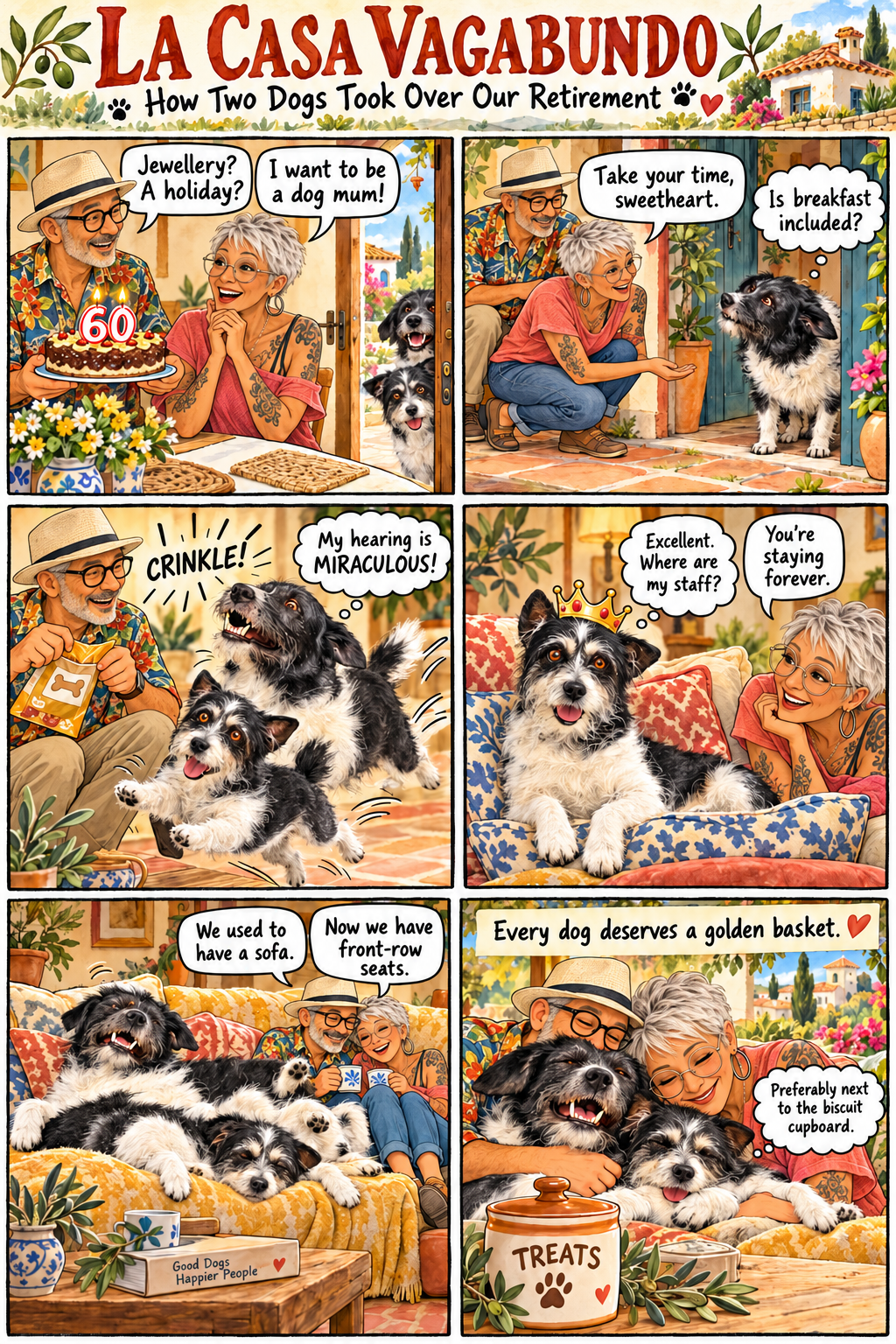
As my sixtieth birthday approached, my husband and son asked what I wanted. Jewellery? A weekend away? A dinner where nobody licked my shoe under the table? “No flowers. No presents. No surprise party. I want to be a dog mum.” There may have been a brief silence while my husband recalculated his chances of a peaceful old age. But that’s exactly what happened. Some people take up golf at sixty. I started fostering dogs. There’s still plenty of walking and picking up balls, except my fellow players don’t wear trousers and occasionally eat the scorecard.
Since then, we’ve helped more than a hundred dogs on their way to their very own forever homes. What began with “perhaps we could help just one” grew into a household where dog beds are permanent fixtures and an empty seat on the sofa is largely a theoretical concept.
Our first guest here in Spain was Lucy. She had arrived at the municipal shelter trembling and crawling, with eyes that seemed to ask just one question: “Will you take me with you, and will I be safe?” We don’t know her whole story. Some dogs don’t come with a past you can read. You only see the traces it has left behind. Doors frightened her. Loud voices did too. But biscuit wrappers? That sound was recognised immediately. Absolutely no connection delay there. One discreet little crinkle, and somewhere behind those frightened eyes, a light switched on: “Is that the catering?”
We suspected Lucy had once lived with an elderly person. Someone who spoiled her, someone who made her feel at home. Perhaps that person passed away and she lost everything afterwards. We don’t know for certain. What we did know was that she had nothing to prove here. She was allowed to be afraid. To keep her distance. To watch. To watch some more. And then, perhaps, decide that we had provisionally passed inspection. Little by little, her confidence grew.
And eventually, the best news arrived: Lucy was adopted. Her own people. Her own home. Her very own golden basket.
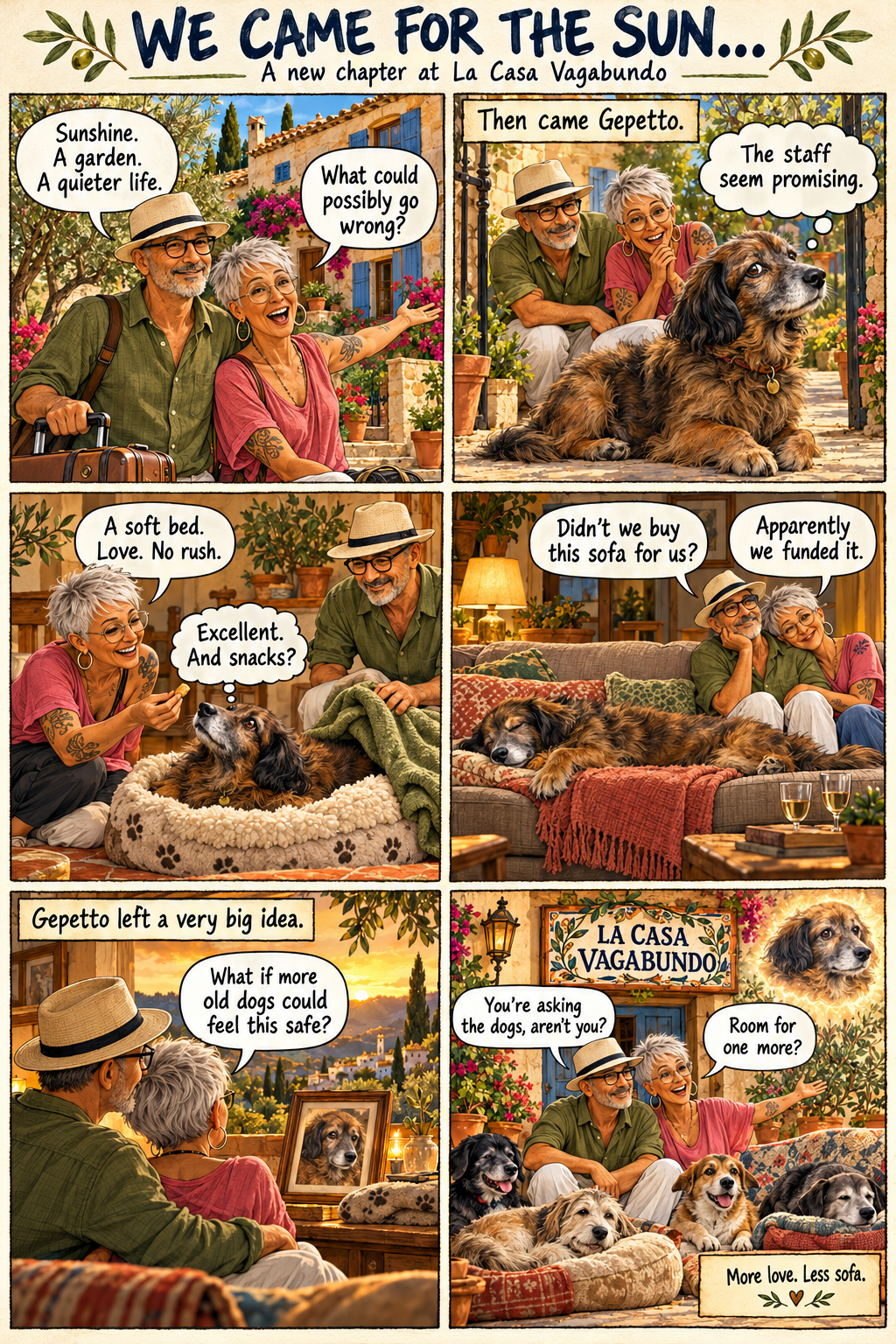
Then came Pecas. Twelve years old. Thirty-five centimetres tall. Blind, struggling to walk and sporting a little grey muzzle that instantly melted your heart. His owner became ill. The family couldn’t or wouldn’t keep him. And so, in his old age, he had to start all over again. He didn’t need to perform tricks. Or break any walking records. Or submit a certificate of good behaviour in triplicate. He could simply spend his remaining years here… And that made Pecas the first official resident of La Casa Vagabundo, following in Gepetto’s pawprints. His retirement package was approved immediately: a safe home, a guaranteed place on the sofa and the option of snuggling into a dog bed with the other four-legged residents. No small print. Plenty of dog hair. Finally, a contract that left everyone better off.
And that was when our adventure truly began.